
The Global Export Landscape
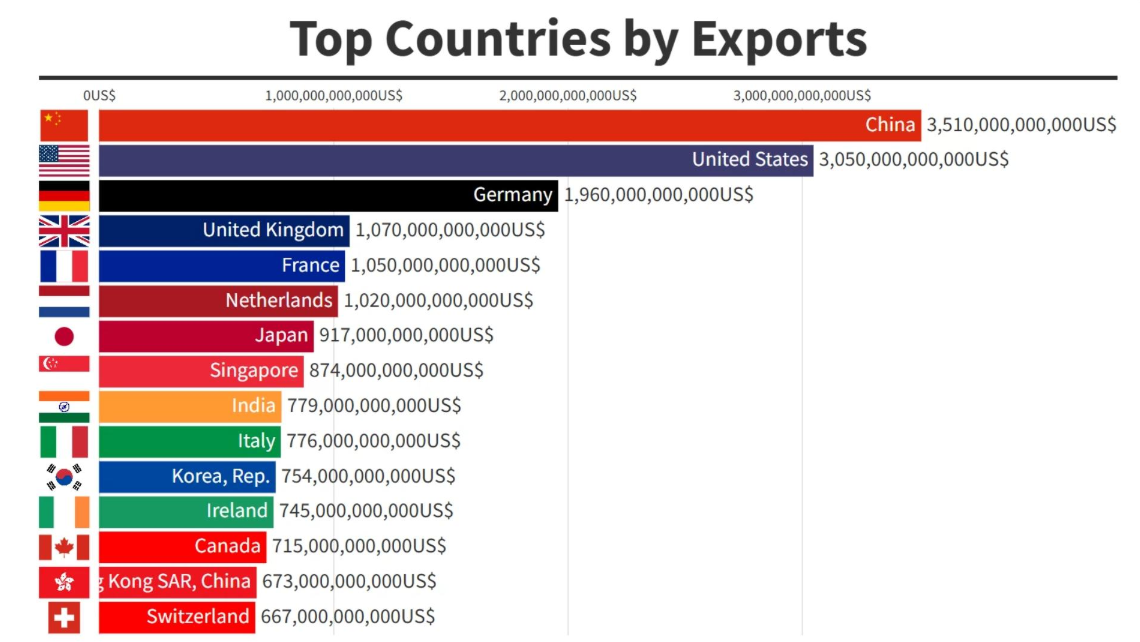
Global exports are dominated by a few countries. China leads by a wide margin, followed by United States and Germany. In comparison, India holds a much smaller share.
This gap is not just about manufacturing strength. It reflects how efficiently these countries move goods across borders. Export leaders have built systems that reduce delays, simplify compliance, and integrate logistics seamlessly. India, on the other hand, still loses time and money in process inefficiencies.
The Export Gap in Perspective
The difference in export value highlights a deeper truth: countries that dominate trade have optimized the entire pipeline, not just production. Faster documentation, better ports, and stronger logistics networks allow them to scale globally without friction.
The biggest lesson from top exporting countries is simple: they don’t just produce goods, they control the end-to-end trade system.
In India, exporters often focus on manufacturing and pricing. In leading export economies, the focus shifts to speed, reliability, and predictability. Every step-from factory dispatch to customs clearance-is engineered to minimize delays.
How Leading Exporters Actually Win
In China, export dominance comes from tight integration. Manufacturing hubs are directly connected to ports, logistics providers, and digital systems. This reduces turnaround time and allows businesses to respond quickly to global demand shifts.
Germany takes a different route. Instead of competing on volume, it competes on value. High-quality engineering goods and precision manufacturing ensure that its exports command premium pricing in international markets.
Meanwhile, Netherlands has built its strength as a logistics hub. Even without large-scale manufacturing, it plays a critical role in global trade by enabling efficient movement of goods across Europe through advanced port infrastructure.
The United States focuses on diversification. By exporting across technology, energy, agriculture, and services, it reduces dependency on any single sector and maintains resilience in global markets.
Where India Falls Behind
India’s challenge is not capability-it is coordination.
Despite having strong sectors like pharmaceuticals and IT, the export process still faces friction. Delays in documentation, inconsistent customs handling, and fragmented logistics systems slow down the entire trade cycle. These inefficiencies reduce competitiveness, especially when compared to countries where processes are streamlined and predictable.
What India Needs to Change
India does not need to replicate another country’s model. It needs to fix its own bottlenecks.
The most critical shift is moving from a production-first mindset to a system-first approach. Trade infrastructure must improve alongside manufacturing. Digital documentation should replace manual processes to reduce errors and delays. Export ecosystems need to be built in clusters where logistics, compliance, and production work together instead of in isolation.
Equally important is the move toward higher-value exports. Competing only on cost is not sustainable. Competing on reliability, speed, and quality is.
In global trade, the winner is not the country that produces the most. It is the country that moves goods the fastest with the least friction.
For India, the opportunity is clear. By fixing process inefficiencies and building stronger trade systems, it can significantly increase its global export share without needing a complete industrial overhaul.