

Global soybean markets moved lower following the latest China-US summit, as traders and agricultural exporters reacted cautiously to the absence of clear policy commitments on agricultural trade. While the summit helped ease some geopolitical tensions between the world’s two largest economies, farmers and commodity markets were left searching for details regarding tariffs, export agreements, and long-term trade stability.
Soybeans remain one of the most politically sensitive agricultural commodities in international trade because of their strategic importance in food production, animal feed, and edible oil markets. China is the world’s largest soybean importer, while the United States remains one of the largest exporters. Any uncertainty between the two economies immediately affects global commodity prices and agricultural trade flows.
Following the summit, soybean futures declined as markets interpreted the lack of firm agreements as a sign that major trade disputes between the two countries remain unresolved. Analysts noted that traders were expecting clearer signals regarding future Chinese purchases of American agricultural products.
Why the China-US Relationship Matters for Soybean Trade
The global soybean market has become heavily dependent on trade relations between China and the United States. During previous tariff disputes between the two countries, agricultural exports became one of the biggest economic pressure points. China imports massive quantities of soybeans every year to support its livestock, poultry, and food processing industries. The United States, Brazil, and Argentina are among the largest suppliers to this demand.
When tensions rise between Washington and Beijing, soybean markets often experience sharp volatility because traders begin adjusting expectations around export volumes, tariffs, and sourcing patterns. The latest summit initially created optimism that agricultural trade cooperation could improve. However, the absence of detailed policy announcements caused uncertainty to return quickly to commodity markets.
Pressure on American Farmers
For American soybean farmers, export uncertainty creates major financial challenges. Many producers are already dealing with fluctuating fertilizer costs, weather-related risks, rising transportation expenses, and changing global demand conditions. China remains one of the most important export destinations for US soybean producers. Any slowdown in Chinese purchases can directly affect farm incomes, storage levels, and commodity pricing across the agricultural sector.
Market analysts believe farmers were hoping for:
clearer trade guarantees,
stronger export commitments,
and reduced tariff uncertainty.
Instead, the summit produced cautious diplomatic messaging without significant agricultural policy breakthroughs.
Brazil Continues Strengthening Its Position
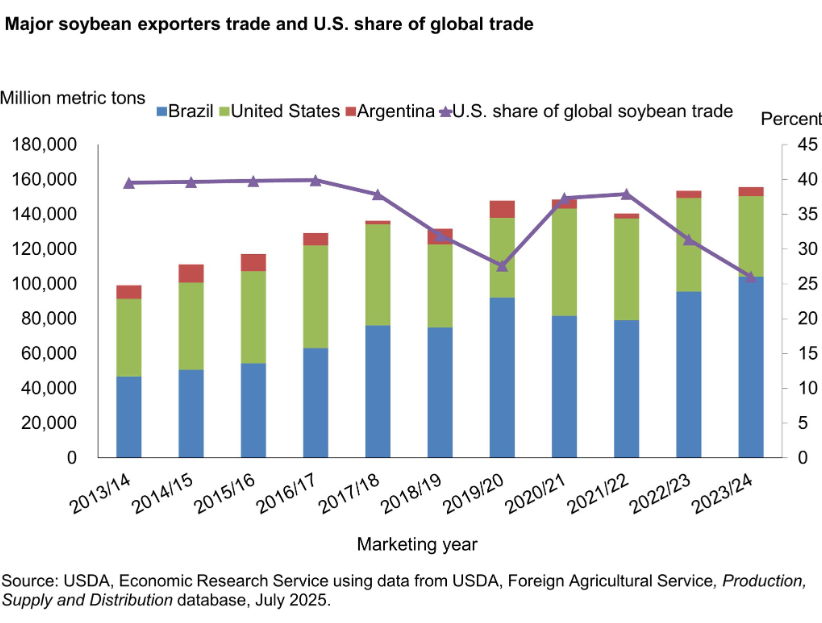
While US farmers face uncertainty, Brazil continues expanding its role in global soybean exports. Over recent years, China has diversified sourcing strategies by increasing purchases from South American suppliers, particularly during periods of tension with the United States.
Brazil’s growing dominance in soybean exports has reshaped agricultural trade patterns globally. Strong harvests, expanding farmland, and improving logistics infrastructure have helped the country increase market share significantly. As a result, global soybean trade is becoming increasingly competitive, with exporters closely monitoring both geopolitical developments and crop production forecasts.
Commodity Markets React to Trade Uncertainty
Agricultural commodity markets are highly sensitive to geopolitical developments because trade policies directly affect supply chains and pricing structures. The decline in soybean prices after the summit reflects broader concerns across commodity markets regarding:
future tariff policies,
export restrictions,
currency fluctuations,
and slowing global demand.
Traders are also closely watching shipping costs, freight disruptions, and weather conditions affecting crop yields across major agricultural regions.
At the same time, global food security concerns continue influencing agricultural trade decisions worldwide. Governments increasingly view food supply chains as strategically important, especially after recent disruptions caused by pandemics, wars, and climate-related events.
Technology and Agricultural Trade
Technology is becoming increasingly important in agricultural commodity markets. AI-powered forecasting systems are now helping traders and exporters analyze:
weather risks,
crop output projections,
shipment patterns,
and geopolitical developments
Advanced analytics platforms are also helping exporters optimize trade routes, monitor pricing volatility, and improve supply chain planning in uncertain market conditions.
As agricultural trade becomes more data-driven, technology infrastructure is emerging as a critical competitive advantage for commodity exporters and supply chain operators.
What Happens Next?
Much now depends on whether future negotiations between China and the United States produce more concrete trade agreements. Markets will continue monitoring signals related to agricultural tariffs, import commitments, and broader geopolitical stability.
If tensions ease further, soybean demand and export volumes could recover more strongly. However, prolonged uncertainty may continue pushing buyers toward diversified sourcing strategies while increasing volatility across commodity markets.
For farmers, exporters, and global traders, the latest summit reinforced an important reality: agricultural markets are no longer influenced only by weather and supply-demand fundamentals. Geopolitics has become one of the most powerful forces shaping the future of global food trade.