

India’s Coffee Export Growth Signals a Bigger Global Shift
India’s coffee exports recorded a strong 27% increase during the January–April period, reflecting rising international demand for Indian Robusta beans and instant coffee products. The surge comes at a time when global coffee supply chains are under pressure from climate disruptions, changing consumer habits, and shifting sourcing strategies.
According to reports, India exported significantly higher volumes compared to the same period last year, with exporters benefiting from both strong pricing and increased overseas demand.
For India’s coffee sector, this is not just a short-term trade story. It highlights how the country is gradually strengthening its position in the global coffee market.
Why Robusta Coffee Is Suddenly in High Demand
One of the biggest reasons behind the export growth is the rising popularity of Robusta coffee.
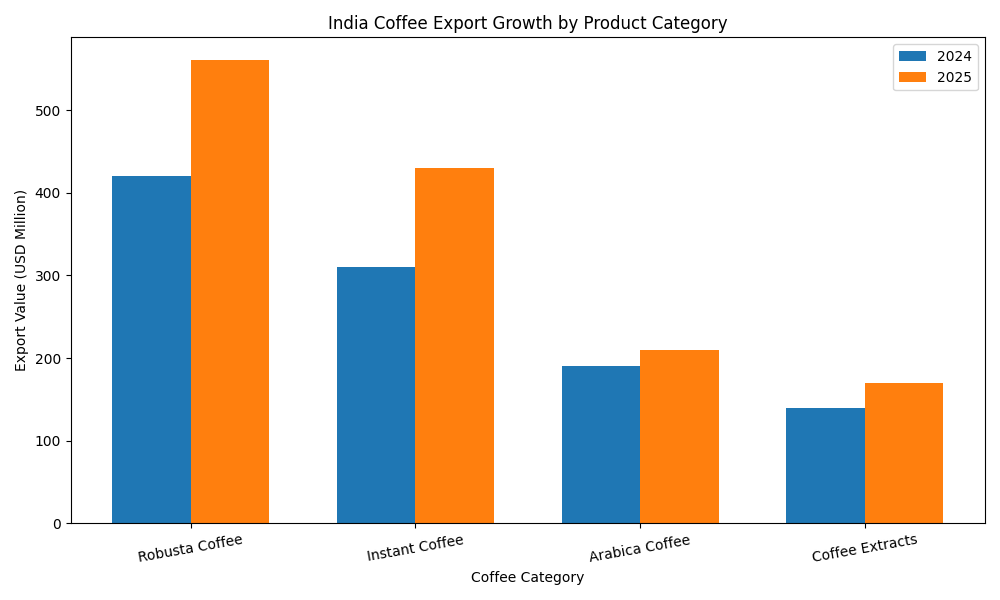
Traditionally, Arabica coffee dominated premium markets because of its smoother taste profile. But over the last two years, global coffee companies have increasingly shifted toward Robusta due to supply shortages and rising Arabica prices.
Countries such as Vietnam and Brazil — two major coffee producers — have faced weather-related disruptions that affected production volumes. As a result, buyers are looking for reliable alternative suppliers, and India is benefiting from that shift.
Indian Robusta is gaining attention because of better quality consistency, competitive pricing, and growing demand from instant coffee manufacturers.
Instant Coffee Is Driving Export Momentum
Another major factor behind the export surge is the growth in global instant coffee consumption.
Instant coffee is no longer viewed only as a low-cost product. In many markets, especially in Asia and Eastern Europe, premium instant coffee demand is increasing due to convenience and changing urban lifestyles. Indian exporters have built strong capabilities in instant coffee manufacturing over the years. Several Indian companies now supply bulk instant coffee to international brands and food service chains. This gives India an advantage because instant coffee exports create more value than simply exporting raw beans. The current demand cycle is therefore helping not just traders, but also processors and manufacturing units connected to the coffee supply chain.
How Indian Coffee Is Competing Globally
India’s coffee industry has traditionally remained smaller compared to global giants like Brazil or Vietnam. However, Indian coffee has carved out a niche in several international markets.
Indian Robusta is often preferred for espresso blends, instant coffee production, and specialty roasting. In addition, India’s shade-grown coffee cultivation method is increasingly attractive to environmentally conscious buyers.
European markets, particularly European Union countries, are showing greater interest in sustainably sourced coffee products. This trend could further strengthen India’s export potential in the coming years.
What This Means for Farmers and MSMEs
The export growth is positive news not just for large exporters, but also for MSMEs and coffee growers connected to the supply chain. Higher export demand generally improves farmgate prices, processing activity, and logistics demand.
States like Karnataka, Kerala, and Tamil Nadu - India’s major coffee-producing regions - could benefit from stronger international orders if demand remains stable. Small coffee processors and packaging businesses may also gain opportunities as global buyers diversify sourcing partnerships.
However, industry experts also warn that export growth must be supported by long-term productivity improvements, better infrastructure, and climate resilience measures.
The Challenge India Still Faces
Despite the strong export performance, India’s coffee industry still faces several structural challenges.
Climate change remains one of the biggest risks. Unpredictable rainfall, rising temperatures, and pest-related issues continue to affect production quality and yields. At the same time, global coffee markets remain highly price-sensitive. If Brazil or Vietnam significantly increase production next season, international prices could soften again. This means India’s coffee sector cannot rely solely on temporary global shortages. Long-term competitiveness will depend on quality improvement, branding, specialty coffee expansion, and value-added exports.
Why This Export Growth Matters Beyond Coffee
India’s coffee export growth reflects a larger trend in global trade.
International buyers are increasingly diversifying supply chains instead of depending too heavily on a few countries. This creates opportunities for Indian agricultural exports beyond coffee as well. Products with strong processing capabilities and consistent quality standards are likely to benefit the most from this shift.
For India, the coffee sector is becoming an example of how agricultural exports can move beyond raw commodity trade toward higher-value global positioning.
Conclusion
India’s 27% rise in coffee exports is more than just a temporary trade spike. It signals changing global demand patterns, stronger acceptance of Indian Robusta, and the growing importance of instant coffee markets.
If the industry continues investing in quality, sustainability, and value-added processing, India could strengthen its position as a major global coffee supplier over the next decade.
For exporters, MSMEs, and coffee growers, the current momentum offers opportunity - but long-term success will depend on how well the sector adapts to global competition and climate challenges.