
Rice is not just another agricultural commodity. For billions of people across Asia and Africa, it is the foundation of daily food consumption. That is why the latest warnings around global rice supply are drawing serious attention from governments, traders, and food security experts.
Recent reports indicate that rice production could tighten significantly in the second half of the year as farmers across Asia reduce planting due to rising fertilizer and fuel costs linked to the Iran conflict. At the same time, forecasts of a strong El Niño weather event are increasing fears of drought and lower crop yields.
What makes the situation worrying is that these pressures are hitting the market simultaneously.
Why the Iran Conflict Is Affecting Rice Markets
At first glance, a conflict involving Iran may not seem directly connected to rice farming. But global agriculture depends heavily on stable energy and fertilizer supply chains.
The Strait of Hormuz - one of the world’s most critical shipping routes - is essential for transporting fuel, urea, and fertilizer-related materials. Disruptions in this region have sharply increased transportation and input costs for farmers across Asia.
Countries such as Thailand, Vietnam, and Indonesia are already reporting reduced fertilizer usage and lower planting activity. For small farmers, this becomes a simple economic calculation. If fertilizer and diesel costs rise too sharply, planting becomes financially risky.
El Niño Could Make the Situation Worse
While geopolitical tensions are increasing production costs, climate risks are threatening yields directly.
Meteorologists and agricultural analysts are warning that El Niño conditions could bring hotter and drier weather across major rice-producing regions in Asia later this year.
Rice cultivation depends heavily on reliable rainfall patterns, especially during planting seasons. Weak monsoons or prolonged dry spells can significantly reduce output. This creates a dangerous combination of higher production costs, lower fertilizer use, and weaker crop yields. Historically, strong El Niño events have often been associated with food inflation and agricultural disruptions across Asia.
India’s Position Becomes Critically Important
In the middle of this uncertainty, India occupies a unique position.
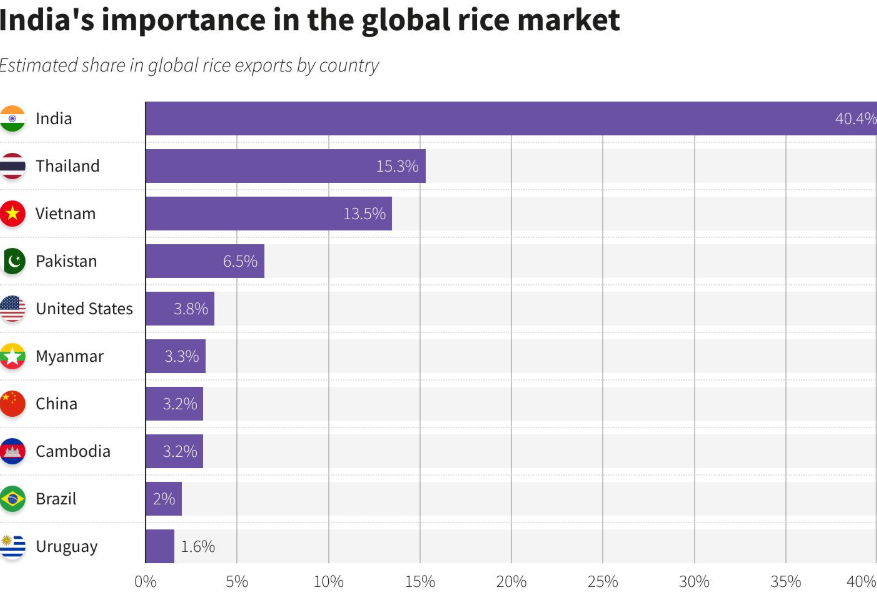
India remains the world’s largest rice exporter and currently holds one of the biggest rice stockpiles globally. According to estimates referenced in recent reports, India controls nearly one-fifth of global rice inventories.
This gives India enormous influence over global food prices. However, India itself is not immune to the same risks affecting the rest of Asia. El Niño-related monsoon weakness could impact domestic rice production as well. There are also logistical concerns. Earlier this year, tensions linked to the Iran conflict disrupted Indian basmati exports, leaving shipments delayed at ports due to rising freight and insurance costs.
The Bigger Concern Is Food Security
The rice market illustrates how deeply interconnected global food systems have become.
A conflict affecting fuel supply routes in the Middle East can increase fertilizer prices in Asia. That raises farming costs, reduces planting activity, and eventually affects food prices for consumers across multiple continents.
For developing economies, rising rice prices can quickly translate into inflation, political pressure, and household stress. The 2008 rice crisis demonstrated how rapidly food markets can destabilize when exporters impose restrictions to protect domestic supply. Many analysts now fear that similar pressures could emerge again if weather conditions worsen and geopolitical tensions continue.
What Businesses and Exporters Should Watch
For rice exporters, traders, and MSMEs involved in agricultural supply chains, the coming months will be important.
If production weakens across Asia, countries with strong inventories could benefit from higher export demand and better pricing. At the same time, logistics costs and insurance premiums may remain volatile due to geopolitical uncertainty. Businesses should closely monitor:
monsoon forecasts,
fertilizer prices,
shipping costs,
and export policy decisions from major producing countries.
Even small disruptions in these areas can rapidly affect global rice pricing.
Conclusion
The global rice market is entering a period of uncertainty after several years of relative surplus.
While current stockpiles may prevent an immediate crisis, the combination of geopolitical conflict, rising input costs, supply-chain disruptions, and El Niño weather risks could tighten supplies faster than expected. For countries heavily dependent on rice imports, the coming months may become increasingly challenging. For exporters like India, the situation presents both opportunity and responsibility.
The real concern is not just whether rice prices rise, but how vulnerable the global food system has become to simultaneous shocks.