
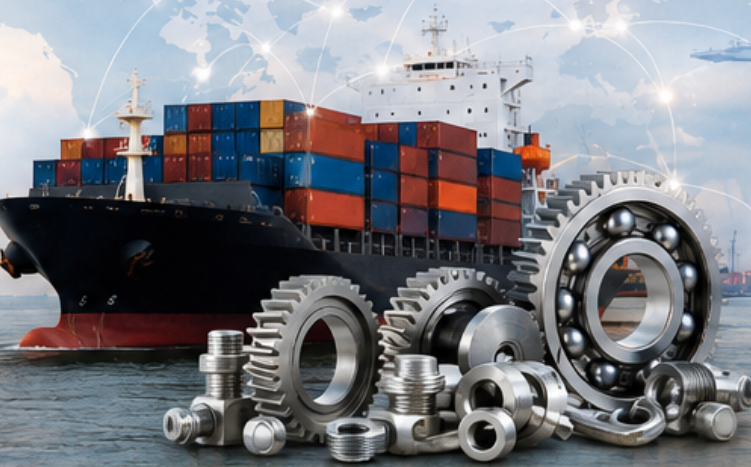
India’s engineering goods exports have begun the financial year 2026–27 on a surprisingly strong and resilient note. In April 2026, exports from this sector rose by nearly 9% year-on-year, even as geopolitical tensions in West Asia continued to disrupt global shipping routes and trade sentiment.
For anyone involved in international trade-whether as an importer sourcing from India or an exporter navigating global markets - this performance is not just a monthly data point. It reflects a deeper structural shift in how India is positioning itself in global manufacturing and trade networks.
At a time when uncertainty dominates global logistics, India’s engineering export sector is showing that resilience is no longer accidental; it is becoming systemic.
A Growth Story Amid Global Disruption
The rise in engineering exports is particularly notable because it comes at a time when West Asia, one of India’s critical trade corridors, has been facing sustained instability. Traditionally, disruptions in this region tend to affect freight movement, insurance costs, and delivery timelines for Indian exporters.
Yet despite these headwinds, engineering exports have not only remained stable but have expanded. This suggests that demand for Indian engineering goods is not concentrated in a single geography anymore. Instead, export markets are broadening, and buyers across multiple regions are absorbing supply more evenly.
A significant portion of this resilience is also linked to India’s expanding industrial export base. Engineering goods are no longer limited to traditional heavy machinery or basic components. The category now includes a wide spectrum of high-demand industrial inputs such as electrical machinery, automotive components, copper and aluminium-based products, and precision-engineered goods.
What Is Driving the Growth
One of the most important factors behind this export expansion is the strong performance of metal-based and mobility-linked segments. Copper and copper products have seen a sharp surge in demand, driven by global electrification trends, renewable energy expansion, and infrastructure upgrades in developed economies. Similarly, aluminium products have grown significantly due to their increasing use in automotive manufacturing, packaging, and energy systems.
Electric machinery and equipment exports have also contributed steadily to overall growth, reflecting India’s growing integration into global supply chains for industrial equipment. The automotive-linked segments, including two-wheelers, three-wheelers, and auto components, have further strengthened the export basket, showing that India is increasingly becoming a hub for mobility manufacturing exports.
What is particularly interesting is that this growth is not dependent on one or two sectors. Instead, it is distributed across multiple industrial categories, which reduces vulnerability and improves long-term stability.
The West Asia Impact: Disruption Without Collapse
West Asia remains an important trading region for India, particularly for engineering goods exported to countries like the UAE and Saudi Arabia. However, the current geopolitical tensions have introduced friction into this corridor. Shipping delays, increased freight costs, and cautious procurement behaviour from buyers in the region have all contributed to some slowdown in demand.
Despite this, the overall export performance has remained positive because losses in one region have been offset by gains in others. Demand from North America, Europe, and select Asian economies has helped balance the trade flow. This shift indicates that Indian exporters are actively diversifying their markets instead of relying heavily on a single geography.
This diversification is becoming a key strength. In previous years, regional disruptions often led to sharper declines in export performance. However, the current trend shows that exporters have become more adaptive, and global buyers are increasingly willing to source from India as a stable alternative supplier.
What This Means for Importers
For importers sourcing engineering goods from India, this trend carries an important implication: supply stability from India is improving even under global stress conditions. Earlier, geopolitical disruptions would often lead to uncertainty in delivery timelines and pricing fluctuations. Now, despite external shocks, Indian supply chains are proving to be more resilient and diversified.
This also means that India is becoming a more competitive sourcing destination. As exporters expand into multiple markets, competition among buyers increases, which can contribute to more stable pricing and better negotiation leverage for importers.
At the same time, importers may also need to prepare for evolving compliance standards, as Indian exporters increasingly align with stricter global quality and sustainability requirements to access premium markets like the EU and the United States.
What This Means for Exporters
For exporters, the message is both encouraging and strategic. Growth is clearly present, but it is no longer coming from traditional or familiar channels alone. The global trade environment is becoming more fragmented, and success depends on how well exporters adapt to this fragmentation.
Exporters who diversify their destination markets, invest in compliance readiness, and focus on high-demand engineering categories are likely to benefit the most from the current cycle. At the same time, reliance on single-region demand—especially in volatile corridors like West Asia—carries increasing risk.
Another key shift is the rising importance of non-tariff barriers. Market access is now influenced less by tariffs and more by certifications, environmental standards, and technical compliance. This is especially true for engineering goods entering developed markets.
Conclusion: A More Resilient Export Ecosystem Emerging
The 9% rise in India’s engineering goods exports in April 2026 is more than a positive statistic. It is an indicator of structural change in India’s trade ecosystem. Despite geopolitical instability in West Asia, India’s export performance has remained strong due to diversification, sectoral strength, and growing global integration.
For importers, this signals reliability and expanding sourcing options. For exporters, it signals opportunity—but also the need for strategic adaptation in markets, compliance, and product positioning.
India’s engineering export story is no longer just about growth. It is increasingly about resilience in a volatile global economy.